Thursday, December 11, 2008

Washington Gets It Right...For Tonight


"We simply cannot ask the American taxpayer to subsidize failure."
--Mitch McConnell, who did not follow the statement with, "And so we are abolishing the income tax."

As of this moment, the auto bailout isn't happening. It might be ugly out there tomorrow, but Tuna Melt thinks bankruptcy for GM & Chrysler now is far better than bankrputcy for GM & Chrylser next year after another 100 billion is down the tubes.

Of course, the big October bailout failed on the first go, only to go back to the House where it collected an additional 150 billion in pork on its way to passing.

Wednesday, December 10, 2008

I'll take the deflationary crisis


This guy is headed to the grocery store in Zimbabwe.

Teach A Parrot to Say Supply and Demand...


When will we reach the bottom?

Keynes (and Obama's team) would say, "when government has stimulated demand enough to match production output."
Tuna Melt says: When bad investment has been liquidated to the point that production has shrunk to match the new, lower level of demand.

Monday, December 8, 2008

Son of Taffy

Making its way around the blogs this weekend, a complete listing of the new bailout agencies.

* TARP: Troubled Asset Relief Program. This is the Treasury's big $700 billion ($850B including pork) program that has been used to prop up financial institutions.
* TAF: Term Auction Facility (or TAFfy). Program by which the Fed auctions funds to financial institutions — allowing them to use their toxic assets for collateral.
* TALF: Term Asset-Backed Lending Facility (or "son of Taffy"). Recently announced Fed program designed to help the market for student, auto and other consumer loans.
* CPFF: Commercial Paper Funding Facility. Buys commercial paper directly from corporations.
* AMLF: Asset-Backed Money Fund Lending Facility. Fed program designed to buy short-term paper (including commercial paper) to prevent money market funds from "breaking the buck."
* TSLF: Term Securities Lending Facility. Fed program that lets banks swap bad mortgage and other debt from their books in exchange for Treasuries.
* SLF: Special Lending Facilities. Originally designed to loan money to fund JPMorgan's purchase of Bear Stearns in March. Also used to back AIG's balance sheet to avoid total collapse.
* PDCF: Primary Dealer Credit Facility. This is the Fed program that allowed broker/dealers and other non-banks to tap the Fed's discount window (back when there were independent broker/dealers).

Saturday, December 6, 2008

Making the Most of Our Current Reality

When the Tech bubble burst in 2000, the stock market lost almost as much as in this current mess (the NASDAQ lost more - it never recovered). Investors on the wrong end of that one were left wondering what was accomplished with all the money they handed over to the dotcoms.

Most of the money from the tech bubble was squandered, but one enduring legacy remains. The world was wired. Fiber optics cable was stretched around the globe. Large scale telecommuting, outsourcing office work to India, video on demand, iTunes, youtube, free wireless Internet at your coffeehouse -- all of this came about because in the 90s the world gave over so much of its money to tech companies.

Today's bubble has burst and left us with a glut of American housing and commercial real estate, so much in fact that the price of real estate is in spectacular freefall. Unlike the global fiber optics network, we can't make productive use of all this investment to a degree that we might justify all the madness.

Or can we?

Friends of the Tuna Melter know that some 12 years ago he worked for National Center For Policy Analysis (for one strange but enlightening summer). You think things are grim now, read NCPA's latest study. Tuna Melt's executive summary for you: in about 15 years, we'll be faced with either defaulting on government debt, or defaulting on government's social security and medicare promises.

Our economy is tanking precisely when we need its strongest growth. The demographics of this nation are such that we're soon headed for a time when more people are old and want to be done working than are young and eager to work. The entitlements monster in Washington is only getting hungrier, and we have fewer people feeding it. It's about to break loose and go on a feeding frenzy that will amount to the climactic finale of American prosperity.

Our choices are:
1) slay the monster by renegging on our Social Security and Medicare promises
2) find a new way to feed it.

#1 is the best, but trust me when I tell you with 100% certainty that it will never happen in the lives of you or your children. Entitlements aren't just a by-product of a democratic republic, they are the definition of a democratic republic. Nothing short of an armed, chaotic, bloody upheaval will end entitlements, and even anarchists like me would rather just pay the fucking taxes so we can play with our kids.
#2 might lay in the ruins of our tattered economy.

Cheap, abundant housing, everywhere you look. More houses than people to fill them......

What if America were to loosen up on immigration just a smidge? I know, I know - there are no jobs for immigrants to take. Just ponder it for now. More on this in future posts.

Friday, December 5, 2008

Friday Morning Melt

So, if Roubini was likely the winner of the last guessing game, what are his future predictions?

In the next few months, the flow of macroeconomic and earnings news will be much worse than expected. The credit crunch will get worse, with de­leveraging continuing as hedge funds and other leveraged players are forced to sell assets into illiquid and distressed markets, leading to further cascading falls in prices, other insolvent financial institutions going bust and a few emerging market economies entering a full-blown financial crisis.


also...

With governments and central banks bringing private sector losses on to their balance sheets, fiscal deficits will top $1,000bn for the US in the next two years. The Fed and the Treasury are taking a massive amount of credit risk, endangering the long-term solvency of the US government.


Full article here.

Also if you're in the mood to surf, check out Why Is Roubini's 401k All in Stocks?

Tuna Melt (who gives all the disclaimers about taking investment advise from Internet blowhards) also likes stocks as a long-term place to park one's butt. Treasuries and cash are instruments of government. Right now government is the only player whose stability seems a sure bet (after all, they get their revenue whether people want to pay it or not). But load a couple trillion in debt onto the government's balance sheet, and private companies starts to look much more stable in comparison.

Tuesday, December 2, 2008

Prediction Out the Tubes

Tuna Melt's predictions that government will grow astronomically as a result of this crisis: like, 100 for 100.

Tuna Melt's prediction that hyperinflation is coming: 0 for 1.

It's a good thing I only have about 4 readers, because I'm as clueless as anyone else. Tuna Melt now thinks that Roubini was right and deflation is here to stay for awhile. Despite the absurd amount of money being printed, it's not enough to overcome the extraordinary freefall of formerly inflated paper assets.

Even though I don't know what the hell I'm talking about, LVM and HB certainly do. The more I study what's happening out there and try to make sense of it, the more stunned I am at how prescient those blokes were.

Smack My Swamp Monster

Thanks to Nilfisk for finding this. It is further proof that our economic woes in fact have nothing to do with debt deflation but in fact are caused by Youtube.

Monday, December 1, 2008

Bernanke Gives Stockholders the Smackdown


From Bernanke's speech today in Austin.

Regarding interest rate policy, although further reductions from the current federal funds rate target of 1 percent are certainly feasible, at this point the scope for using conventional interest rate policies to support the economy is obviously limited.


He went on to announce an unprecedented step. The Fed will start buying US Treasuries. Ignoring the mind-bender paradox of the government's bank buying the government's bonds, this announcement led to a new race into the Treasury market.

Last week, everyone started getting out of Treasuries (finally) as the reality started sinking in that the government might be getting in over its head. The stock market had its best week in decades.

Today, Bernanke told investors that there was a new, giant customer soon to get into the game who would buy those silly Treasury bonds by the boatload.

The result? Everyone wanted a Treasury bond. To get cash to buy these new golden tickets, they sold their stocks. Dow down 700.

Sunday, November 30, 2008

Coming Soon, Higher Interest Rates

Another problem with trying to finance our grand recovery schemes with debt.

To do all Obama wants to do, on top of what Paulson & Bernanke have already done, America needs a lot more money from China. At some point, China will decide that American debt is riskier than it used to be and will demand a better deal on their loans. In other words, higher interest rates are coming on Treasuries.

Those higher interest rates will push interest rates up through the entire American financial system, providing us with higher rates precisely when the orchestrators of our monetary policy want interest rates to drop.

The real reason for the season

Perhaps our economy's tanking because all our productivity's been sucked into the Youtube vortex. Speaking of which, check this out. Quite awesome.

Saturday, November 29, 2008

Some Hope From the Melt

Remember a few weeks ago when Treasury elected not to buy the mortgage backed securities, and instead use their money to inject capital into banks (and ultimately, to prop up Citigroup by $320 billion)?

So, what happened to all those "toxic" securities then? Read this. It's an amazing lesson in how this whole fiasco should be handled. Washington just needs to get the f*ck out of the way.

What Happens When The Debt Grows Too Large?

Tuna Melt intends to do lots of research and make some predictions about where things are headed now that the US government is putting itself into an unprecedented amount of debt. Perhaps in the big scheme of things, all this debt will only be a drain on the economy that can be overcome with a few good years (by the mid-80's, there was lots of fear that the US would never get out of the Reagan debt, but after the arms race ended, it happened rather quickly, maybe we'll be so lucky again).

Or, perhaps we're just a few more sandbags away from sinking this balloon. What happens if that's the case?

I don't know. That's why we have the Internet. Let's all figure this out together. For starters, let's take a few moments to learn what we can about the Latin American debt crisis of the 80s

Friday, November 28, 2008

Friday Night Off the Cuff Solutions to the World's Problems

Readers probably know how Tuna Melt would solve the financial crisis. It involves private defense companies.

But what if Tuna Melt were to propose politically feasible solutions (ie - things that could actually be done by politicians today if they had the desire to do so)? Here we go.

#1. A moratorium on all new government debt. No new Treasuries issued until further notice. We've got to get the investment capital going back to productive purposes right away, like stocks and corporate bonds.

#2. Capital gains tax gone, completely gone, right away. Even the most hardened socialist now knows that this is a nonsense tax that actually reduces overall tax revenue simply through its existence. It only sticks around year after year because people are petrified that the uber rich could completely finagle their way out of paying taxes at all were it not present.

#3. Stimulus? Yes. The good old fashioned way. Tax rebates. The Keynesians are falling all over themselves to argue that the summer stimulus checks didn't work, but that's not what I saw. The prices of oil, gold, steel, food, EVERYTHING, took off like a rocket in the two months following that oh so sweet mailing (I have two kids -- my check was a nice fat one). The market is smart that way. Our rebate checks last summer were made entirely of funny money, financed with government debt, and the market heartily responded. The dollar plummeted, prices went up, tah-dahhh! This time....wait, didn't we just say no new debt?

#4. Cut government spending in line to match the rebate stimulus being sent out. Yes, I know, this was supposed be politically feasible. Allow a guy to think, if only for a moment, that in times of crisis, Washington actually could find a way to pull it together. They can't...I know it and you know it....oh man...we're screwed. But, supposing they could...note that the exact opposite of this is what's being proposed. Keynes's ghost looms in Washington right now, telling those goobers that the road to recovery is paved with government expenditures, but we're seeing quite clearly as we speak that it is not. Government can finance their expenditures through tax increases (would be disastrous) or debt, and government debt more than anything is what's strangling the credit markets, and unstrangling the credit markets is priority one in rescuing the economy.

#5. Pass income tax cuts. Pass 'em to whatever brackets you want. As big as you can make 'em.

#3 would be the only temporary measure. The rest would be permanent. The rest would result in long-term growth, enough growth that we might pay down some of this debt before the Medicare crisis arrives. What's that? you say. Medicare crisis? Did you not know that we've got a meltdown on the horizon that makes this one look like the '92 recession? That will be for another post down the road. That post might be titled "Default."

Follow The Bouncing Funny Money


90s: all stocks, but tech stocks in particular
2001: first half of 2005: all real estate, but American housing in particular
first half of 2005 - first half of 2008: commodities. oil, gold, silver, copper, food..
second half of 2008: US Treasuries, the dollar, the yen.

The loose money of the Fed has resulted in a roving speculative bubble that blobs from one section of the economy to another, sucking real investment along with it as it goes, and leaving tremendous overcapacity behind when it leaves. The amount of loose money pumped in from 2001-2004 grew the blob to such size that we've found trillions of dollars worldwide mis-invested into capital projects with no return. Down goes Bear Sterns, Lehman, Washington Mutual, Wachovia...

What's frightening now is that the over-investment is in US treasuries. At least when the loose money was in housing, a house was built. Now that it's in Treasuries, the loose money is funneled straight into the Washington productivity incinerator.

Thursday, November 27, 2008

this is great

This Thingsgiving, I am thankful for things like this.

Word's Getting Out 2

An increasing number of mainstream outlets are calling for changes that we nutjobs on the fringe have wanted for years.

Wednesday, November 26, 2008

Word's Getting Out..

...from an AP wire story today that got picked up by all the major papers:

"One big worry stifling activity in the markets is that if the government is doing so much lending and backstopping now, it's going to need to do a lot of borrowing, too, to finance those efforts. And if the government is seeking lenders to buy its debt, what is going to happen to other borrowers looking for lenders?

As the Federal Reserve and Treasury act to rescue borrowers, Simons said, 'they're starving other private sector borrowers.
'"

It's a good sign that the mainstream is acknowledging this.

What's happening right now is the final stake in the heart of Keynesian economics, or maybe I should say, would be the final stake if Keynes wasn't so damned appealing to politicians. Keynes was a hearty advocate of using government debt to "stimulate" us during economic downturns. In the past few months, we have followed the Keynesian prescription in the most extraordinary way imaginable, and it's becoming clear that the very act of doing so is why the credit crunch continues.

Even as commercial banks are eager, desperate even, to find borrowers for small, standard loans (notice all the 0% auto loan commercials are back, just as they were in late 2001?), the corporate bond market remains in a death spiral. No one wants to buy corporate debt. Why would they? At this time last year, Citigroup bonds were 5-star, good as cash assets (trust me, this I know well). 12 months later Citigroup was circling the drain and got the biggest bailout yet. The rating schemes on which the entire bond market was based have turned out to be crap, and who wants to buy crap when you can buy a United States Treasury Bill?

The Legacy

The welfare state is the primary negative outcome one can point to regarding Great Depression 1. An oppressive, strangling burden of government debt will the primary negative outcome we'll point to on the other side Great Depression 2.

That is, of course, unless the US Treasury ultimately defaults.

At the beginning of all this, I spoke of default on government debt rather flippantly. "Ha, ha -- they keep this up, we'll end up in a spot where the government will default some day."

Ha ha.

Monday, November 24, 2008

Math Problem

The Washington Post:
"Facing an increasingly ominous economic outlook, President-elect Barack Obama and other Democrats are rapidly ratcheting up plans for a massive fiscal stimulus program that could total as much as $700 billion over the next two years....Obama has set a goal of creating or preserving 2.5 million jobs by 2011."

Class, grab your pencils and prepare for a long division 'story' problem. Here we go.

The American economy has gone under and millions of people are losing their jobs. The amazing new president, The One, "The Grownup," ("America, F*ck yeah!") has come up with a plan to create and save millions of jobs. Congress has given him $700 billion dollars to spend on his plan. If Super Obama spends $700 billion to create 2.5 million jobs, what is the average amount he spends on each job created?

The Melt Returns

What's the biggest difference between October 2008 and October 1929?

In October 1929, there were no Treasury bills. They didn't get first issued until December of that year.

This is what got me down on Friday. All sorts of interesting things have happened these past few months, good and bad, but the most interesting of all, and the most bad by far, is the historic flight to Treasury bonds.

In times of uncertainty, why would anyone invest their cash in a business, which has to deal with the rigors of survival in a tanking economy, when they can put their money in Treasury bonds for a guaranteed return? And if everyone is willing to buy government debt, even at ZERO YIELD, why wouldn't the government expand its debt base?

Rather than having a market give money to those who can make it grow, which is the whole idea of capitalism, we instead have everyone loaning their money to the government, and the government in turn giving that money to people who have an unusual aptitude for making it shrink.

When all this started, people were fascinated by my pessimism at where this all might lead, but not even I thought it would get as bad as this. Government debt has royally screwed up our capital markets. This mess started with an explosion of bad debt, but it has spilled over into the mother of all economic downturns because the people who have the capacity to PRODUCE something can't get any money to do so. All the MONEY has been lent to the government!!

And the bigger problem is the way the bureaucrats are salivating at all this cash investors are throwing their way. The plan now is for Congress to draft and pass a "stimulus" package in time for Obama to sign it on his first day. The gossip about this plan is....

...beautifully absurd.

And now we all must take a deep breath and enjoy this ride, because this sucker's about to get wacky. The great Terry Gilliam movie Brazil is coming to life before our eyes. New airport runways, giant windmill farms, new bridges, old bridges, new roads, new railroads, "green" car-building factories, and any other excuse to give away all this cash to people who can help the politicians get rich and re-elected. All is on the table. All will be financed by the debt money. All will be overseen by government, so none of it is gonna work. A million new little defective projects all over America. "Bailout" is going to be replaced in our lexicon with "stimulus," as in, "Where's my stimulus?" "Harry's family got in on the stimulus," "He's just a no-good stimulus-grabbing loser." Twenty years from now, the landscape will be cluttered with beautiful, rusty ruins. We'll call them "stimulus projects."

This Is Pretty Incredible

Peter Schiff is an Austrian economist with his own financial firm. Wish I'd been paying attention.

Friday, November 21, 2008

Tuna Can't Blog

Tuna Melt is crashing all the trusted economics and financial sources to bring you the greatest coverage of GFM, as per usual....and must take a night off.

Tuna Melt has been predicting GFM for eleven years, since he first read HB's great works of the 70's. Tuna Melt came to believe that he had no idea what was going on when GFM never came and turned his attention elsewhere.

Now that GFM is on, Tuna Melt has been amazed at how right HB was all this time.

Tonight, what Tuna Melt is seeing out there in the world of economis and finance is the scariest Tuna Melt has ever seen in the eleven years that Tuna Melt has been predicting GFM. Needless to say, if there was a real blog post tonight, it might say something like, "Buy a shotgun."

Tuna Melt hopes to soon enter another 11-year span where Harry Browne was wrong. Lights out until Monday.

Thursday, November 20, 2008

Forget 1929

Does anyone else think this is starting to look like the panic of 1819?

Another Trillion Dollars Wiped Out Today

Who cares? Really, is it that important? It's only money.

Tuna Melters, the video below shows what it looks like when people have to deal with genuine tragedy. It isn't pretty, but I hope you'll suck it up and watch. We all need some perspective.

Wednesday, November 19, 2008

Top 5

Most evil politicians (an easy one - just go by body count)

5. Josip Broz Tito
4. Pol Pot
3. Hitler
2. Stalin
1. Mao (he should actually own the top 100 spots all to himself. this was one evil dude).

Most evil US Presidents:

5. FDR
4. GW Bush
3. Lyndon Johnson
2. Theodore Roosevelt
1. Woodrow Wilson (like Mao, absolutely dominates the list. This was one evil dude).

Sleaziest Current American Politicians (per Nilfisk request)

5. John Edwards (would have been #1, but this dude is so sleazy he got called out and is hardly even a politician anymore).
4. Hillary Clinton (every word from her mouth is so drenched in sleaze I must turn the channel when she comes on).
3. Mitt Romney (sleazy and slick go together so well)
2. Ron Paul (the fact that he actually understands economics and still plays the games necessary to stay in Washington is evidence of one Grade A sleaze).
1. Harry Reid (he's the key player so far in the auto bailout madness, which is the sleaziest game in town right now, so he takes the #1 spot -- speaking of which, have you read the latest?)

Tuesday, November 18, 2008

Insider Blogging

Interesting.

And now, for old time's sake, we dip into the bountiful wisdom of HB.

Public Choice Theory in Action II

A must-read article for anyone interested in how democracy works.

Sunday, November 16, 2008

In Your Backyard

In my hometown, the recession just made its first big kill.

Saturday, November 15, 2008

A Youtube Classic For A Saturday Afternoon

The Bailout - Public Choice Theory in Action

Your average university economics professor harbors a dirty secret. She's a professor, so she leans left (she had to to get the job), but after years of thought about the provision of goods and services in a society, even the most hardened leftist with any intellectual honesty is forced to accept three free market truths. These truths have been so thoroughly studied, debated, and resolved in the academic journals that there is no place for a market hater to hide, even in a university. They are:

1) Free trade between nations always results in an improved standard of living for both sides.
2) The minimum wage hurts the poor more than it helps them.
3) Representative democracy creates tremendous incentives for all involved to engage in "rent seeking" and theft.

#3 is an entire field of economics, called Public Choice Theory.

The $700 billion bailout has turned Washington into a full-on Public Choice Theory experiment, perhaps the largest ever undertaken. Congress approved an unprecedented amount of cash for open handouts. Let the games begin!

Case in point: the auto industry. On Monday, the Senate will begin discussing the 25 billion auto industry bailout. Here's how this works. Washington democrats have spent their entire lives decrying corporate welfare, but now find themselves arguing passionately for one of the largest and most ridiculous corporate welfare checks in history. They're doing so even though their constituencies despise the idea.

Why? Three reasons.

1. The American auto industry is most important to Michigan, Ohio, and Pennsylvania -- crucial swing states all.
2. In January, the Democrats will take full ownership of Washington and everything that comes out of that town will be on their shoulders.
3. Unions make up a small percentage of democratic voters, but a large percentage of democratic donors.

The goal is to get a bill passed before Bush is out, so that he will be faced with the decision to veto. Everyone knows that this bailout package isn't just a bad idea, it's a truly, truly terrible one. Everyone also knows that Michigan and Ohio are going to remember this vote for a generation.

Further, despite being the party whose public face HATES corporate welfare, the bankruptcy of the Big 3 means the potential dissolution of the United Auto Workers and their tremendous financial might. This $25 billion is being floated with the goal of getting a ton of it back in future campaign contributions.

And hence we may be faced with the absurd prospect of Bush signing a bailout bill into law, a bill that Republican voters oppose, but that Republican operatives need in order to please the swing states. It's a bill put forth by a Congress who knows it's wrong, and knows it is against the wishes of their voting base, but also knows that voters in California will be quick to forgive, but voters in Ohio will be slow to forget. Go democracy!

To Bailot or Not To Bailout

Thursday, November 13, 2008

How's That Bailout Working For Ya?

It's not just the auto industry. Everyone wants a piece of the bailout pie.

From an article in the NY Times (who, like GM and Ford, will be bankrupt by 2010 unless we float them billions of stolen cash):

"The Treasury Department is under siege by an army of hired guns for banks, savings and loan associations and insurers — as well as for improbable candidates like a Hispanic business group representing plumbing and home-heating specialists. That last group wants the Treasury to hire its members as contractors to take care of houses that the government may end up owning through buying distressed mortgages."

Wednesday, November 12, 2008

Another Tuna Melt Prediction

Make no mistake, this blog is all about doom and gloom.

But we'll take a break for something more optimistic. Here's another Tuna Melt prediction.

Sooner than you think, solar energy will be entirely viable and profitable for so many applications that most of the jibber jabber about peak oil and global warming will go away (sure to be replaced with new, equally pointless jibber jabber about dead nanobots in our food supply or whatever). Successes with nanotechnology in labs around the world a few years ago is now translating to new factories in China to make nanosolarbot paint and other weird stuff that's about to become buzzwordworthy.

Right now, solar can only provide a tiny percentage of the world's energy needs, but a few years ago, it could provide only a fraction of a tiny percentage. In other words, get ready because this chariot's about to race. You'll know we've hit the elbow in the growth curve when GE and the oil companies start announcing gigantic solar manufacturing initiatives. The tech bubble will return full force and we'll call it "The Green Bubble." Let's all agree to get in early this time.

Tuesday, November 11, 2008

Not that any of you need convincing that the Big 3 need to go bankrupt, but if you're keen on a long blog post about just how screwed up the American auto industry is and what a terrible, terrible idea a bailout is, Megan Mcardle at Atlantic Monthly has written one.

Here's an excerpt.

"Having driven the companies right up to the verge of bankruptcy, [the United Auto Workers] conceded literally only when it became clear that the union members were about to get their contracts unilaterally rewritten by a judge, lose their health benefits, and possibly get their pensions crammed down by the PBGC, which maxes out somewhere slightly north of $40K per annum. Then the unions ever so generously agreed to cut health care costs by 30% in exchange for job security guarantees. And now that their game of collective bargaining chicken has resulted in the obvious disaster, they want us to pay to save their jobs, at a cost of over $300,000 per."

Monday, November 10, 2008

Lessons From the First Great Depression II

It wasn't just the top tax rates. From the definitive paper on fiscal policy in the thirties:

"The primary failure of fiscal policy to be expansive in this period is attributable to the sharp increases in tax structures enacted at all levels of government...The Revenue Act of 1932 pushed up rates virtually across the board, but notably on the lower and middle income groups....Personal income tax exemptions were slashed, the normal-tax as well as surtax rates were sharply raised, and the earned-income credit equal to 25 percent of taxes on low income was repealed. Estates tax rates were pushed up, exemptions sharply reduced, and a gift tax was provided. Congress toyed with a manufacturers' sales tax, but finally rejected it in favor of a broad new list of excise taxes and substantially higher rates for old ones...."

Lessons From the First Great Depression I

Inflationary bubbles burst about once every decade. Every single recession in the United States since 1913 has been caused by a preceding Fed-fueled boom. Recessions typically last for about 6 months, bad investments get liquidated, and normal economic activity resumes.

But in October 1929, a particularly bad bubble popped, and the downturn lasted for 15 years. Why was that one so much worse?

Here's the first reason.

I, Pencil

A comment by Nilfisk leads to an invitation to all Tuna Melt readers to check out this 1958 essay and ponder the fallacy that government can "stimulate" the economy by handing out cash to politically connected construction companies.

Extra! Extra!

The headlines this morning:

AIG gets $40 billion more bailout money.

Obama's new chief of staff is an advocate for an auto industry bailout.

China's government unveils a $600 billion stimulus plan.

But amidst all the daily madness, thus far there hasn't been any noise yet about this.

Saturday, November 8, 2008

Bring Back the Edsel While We're At It


Apparently, Congress wants the Treasury department to give some of the $700 billion bailout money to the Big 3 automakers.

"A healthy automobile manufacturing sector is essential to the restoration of financial market stability, the overall health of our economy, and the livelihood of the automobile sector's work force," Congress says.

I agree, but floating billions to companies that should go under is no way to make for a healthy sector.

The Big 3 need to go under. Toyota, Honda, Mitsubishi, Volkswagon, whomever needs to come in and buy them. Frightening as that will be for many Americans, it is the only way America will ever have a healthy automobile manufacturing sector.

Yes, the capital will be owned overseas, which kind of sucks for us, but the factory jobs will stay here, and for the first time in my lifetime, American automobile factories will truly be able to compete.

Why? Because the United Auto Workers won't be able to bully around foreign companies. The auto unions will be left with a choice: work for a living like everyone else or watch all the jobs go someplace else.

Friday, November 7, 2008

Democracy At Work

Christina Aguilera on Prop 8's failure in California:

“I don’t understand how people can be so close-minded and so judgmental. We chose an African-American president who means so much in a time in history of great change and open-mindedness. Why is this any different?”

On the ballot, Prop 8 read, "Eliminates the right of same sex couples to marry." It passed. Gay marriage in CA is done, for now.

The Mormons were the money machine behind passing this ballot initiative.

I'm guessing, could be wrong, but guessing, that a majority of Mormon voters went for McCain.

Until 1978, blacks were denied full membership in the Mormon Church.

I'm guessing, could be wrong, but guessing, that a majority of black voters went for Obama.

But on the fateful day of November 4th, blacks and Mormons, regardless of their presidential votes, regardless of party affiliation, put that whole "mark of Cain" thing behind them and came together as one to CRUSH the gays.

I love democracy. Without democracy, it would be so hard to arbitrarily but severely punish those that irk us for no good reason.

Wednesday, November 5, 2008

RIP Michael Crichton

The articles on the Internet emphasize The Andromeda Strain as the novel that invented the techno-thriller, the amazing success of Jurassic Park, the longevity of ER, and the controversy surrounding State of Fear.

For me, Crichton is high on my list of authors because of Disclosure, which I would rank among the all-time great page-turners.

The last time I re-read Disclosure, it didn't feel as revolutionary as when I first read it, but I think it's because every thriller written since (including the Great American pro wrestling novel) by necessity must co-opt some of the plot devices he used to such effect in that novel.

Back to Reality

Try as I might, I cannot bring myself to be excited about a new president, and as I watched the footage of people falling over themselves in joy, I wished I too was that excited and hopeful. What a nice moment for all those people.

Alas, I really didn't care who won.

But this...THIS fills me with love, joy and inspiration. It gives me hope for humanity. I hope it does the same for you. Enjoy.

Tuesday, November 4, 2008

Obama Wins!!! OMG!!!

Rosy Thought For the Evening

Writes University of Buffalo Professor Michael Rozeff:

"The $700 billion bailout adds immensely to an unstable arrangement that will end in the collapse of the U.S. government. When? With some probability, it could happen at any time -- due to an unanticipated event involving a foreign country's currency or financing, such as a currency collapse in Russia or Korea. With some probability, it could start in and grow as the deficits grow rapidly now and when Medicare expenditures balloon. It took about 5 years, from 1918 to 1923, for Germany to collapse. The exact timing and nature of the triggering event or events can't be known now. The 1997-1998 Asian crisis was warning 1. The current crisis, which may suddenly grow worse at any time despite the current respite, is warning 2. There may not be a warning 3. The international monetary system is falling apart. Even if the system totters on for awhile, the growth will be anemic."

A Friendly Reminder From Tuna Melt


“I don't vote. Two reasons. First of all it's meaningless; this country was bought and sold a long time ago. The shit they shovel around every 4 years doesn't mean a fucking thing. Secondly, I believe if you vote, you have no right to complain. People like to twist that around – they say, 'If you don't vote, you have no right to complain', but where's the logic in that? If you vote and you elect dishonest, incompetent people into office who screw everything up, you are responsible for what they have done. You caused the problem; you voted them in; you have no right to complain. I, on the other hand, who did not vote, who in fact did not even leave the house on election day, am in no way responsible for what these people have done and have every right to complain about the mess you created that I had nothing to do with.”
--George Carlin

Sunday, November 2, 2008


Trade

From India, a point about Obama versus McCain that has been absent from the discussion in America.

"McCain has voted 88% of the time against bills creating trade barriers, and 90% of the time against export subsidies for US producers. Few other senators have such a splendid record."

Of all the horrible government interventions that turned the 1929 panic into The Great Depression, perhaps the worst was the near shut-down of global trade as every nation tried to subsidize their own exports and tariff the smoot out of their imports.

Saturday, November 1, 2008

More Unsolicited Investment Advise From A Poor Bloke

I don't know why I keep making market predictions. To be clear, I have no investment income to speak of, no investment record other than simple stocks (of which I own none right now) and mutual funds, and my 401K looks as bad as everyone else's right now.

That said, I'm now prepped to tell you about "the next big thing." Were you too young to get in on junk bonds in the 80s? Miss the tech boom? Buy a house after the price explosion was already on?

Here's where to go next.

Put options on U.S. Treasuries.

"What?"

Here's a primer.

When the dollar starts to dive, all the trillions of dollars that moved out of the stock market and into US Treasuries will reverse course. Make your arrangements early and get rich, yo.

To extend the disclaimer that began this post, unless I sell the novel for 6 figures, I won't be taking my own advice on this one. For regular Schmoes (not Joes, mind you -- I ain't no plumber), this sort of shit just isn't practical. You could lose your shirt.

Why Does Tuna Melt Expect Inflation?

Go here.
From the leader of "White Aryan Resistance" who prefers Obama to McCain.
"See, I’m a leftist. I’m not a rightist. I hate the transnational corporations far more than any black person."

Other surprising views from avowed racists in this Esquire article.

Friday, October 31, 2008

Roubini Bets Against the Melt

A few posts ago, Tuna Melt predicted inflation was coming, and it would lead to a rapid "recovery" of the stock market.

Nouriel Roubini of NYU, who's become the go-to guy for GFM 2008, predicts just the opposite.

Game on, Roubini.

Here's where Tuna Melt disagrees with you:

You say:
"First, the massive injection of liquidity in the financial system--literally trillions of dollars in the last few months--is not inflationary, as it accommodates the demand for liquidity that the current financial crisis and investors' panic have triggered."
TM says: And the dollar has benefited from everyone's desire to get into cash. But there's a buttload of cash out there now. More than at any time in the dollar's history. At the first hint of an upward trend in any asset market, the cash will start to move in, and the snowball will roll. You say central banks can and will mop up the excess before inflation starts. I say they tried that in 06, 07 and caused GFM oughteight.


You say:
"As long as deficits are financed with debt--rather than by the printing presses--fiscal costs will not be inflationary, as taxes will have to be increased over the next few decades and/or government spending reduced to service this large increase in the stock of public debt."
TM says: have you met the United States government? Don't forget that a Social Security/Medicare disaster is looming a decade out. The only way Big G can finance all the schemes in store for us is with the printing press.

You say:
"Wouldn't central banks be tempted to monetize these fiscal costs--rather than allow a mushrooming of public debt--and thus wipe out with inflation these fiscal costs of bailing out lenders/investors and borrowers? Not likely in my view. Even a relatively dovish Bernanke Fed cannot afford to let the inflation-expectations genie out of the bottle via a monetization of the fiscal bailout costs."
TM says: On this you are correct, but I think it's already too late for poor Ben. The Fed has pumped out an unprecedented amount of cash into the world and we're nearing the point where foreign investors don't want to touch American debt.

Thursday, October 30, 2008

Madison would be ashamed.

From Federalist #10

"The influence of factious leaders may kindle a flame within their particular States, but will be unable to spread a general conflagration through the other States. A religious sect may degenerate into a political faction in a part of the Confederacy; but the variety of sects dispersed over the entire face of it must secure the national councils against any danger from that source. A rage for paper money, for an abolition of debts, for an equal division of property, or for any other improper or wicked project, will be less apt to pervade the whole body of the Union than a particular member of it; in the same proportion as such a malady is more likely to taint a particular county or district, than an entire State."

Are you an elector? Then why are you voting for President?

Madison and others knew that democracy inevitably turns into grand, organized theft, and tried to curb it by making the Union a republic. But democracy turned out to be much more insidious than they ever imagined. States quickly starting choosing "slates" of electors via popular vote, and that was enough to let "the influence of factions" run rampant.

Will the US go bankrupt?

The US government is on pace to go so deep into debt that the solvency of the whole operation might one day come into question (unless the dollar tanks and the existing holders of Treasury bonds find themselves holding more worthless paper....hmmmm....).

Where might this all lead?

Today the earth has a real-time example of a first world country that's become entirely insolvent. Let's watch what happens with Iceland and see what might be in store for America some day.

More Crystal Balling

It's hardly a prediction to say Obama will win. The sun will rise, the earth will turn, the government will grow, and Obama will win.

Tuna Melt thinks the recent media reports of McCain gaining in the polls won't amount to anything. Not only will Obama win, but the democrats will crush, and I mean CRUSH, in the Congressional, state, and local races. And then in 2010 the Republicans will retake Congress in their own crushing win. And on and on...the government grows...the flow of confiscated money continues...from the politicians to the domestic bureaucrats to the tort lawyers to the bottom of the Atlantic Ocean.

Wednesday, October 29, 2008

...meet the nerdy cynics.

All You Adorable Voters...

Tuna Melt Steps Out On A Limb

The man behind the curtain of this blog has been content to make general political predictions that are safe to put out there. Bet that government will always grow and make even bigger messes and you'll always be right.

But tonight I'm feeling a bit more reckless. Junk bond trading hedge fund leveraging capitalist reckless.

Tuna Melt predicts that the stock market is going to come roaring back much faster than anyone (including me) ever expected when this unraveling began.

Why?

Because the dollar is about to take a nosedive. Stocks, oil, gold, silver, steel, food, and everything else that's come down from the stratosphere in the past few months (with one exception)* will find their way back to pre-GFM or near pre-GFM prices soon.

Forget the proverbial spigot. The Fed now has the fire hoses out and open to full blast. For the past few weeks, banks have been collecting all the water, but soon their stores will be full and the floodgates will open.

Stocks will rise for the simple reason that more dollars will be required to express the same values.

Fill up your gas tanks now.


* the exception is housing. It filled the role of biggest bubble in the recent pricing explosion. Regulators won't let that happen again. The uber-bubble will form somewhere else. Chinese real estate anyone?

Saturday, October 25, 2008

Friday, October 24, 2008

This Novelist Needs a Bad Metaphor

Subprime mortgage derivatives = bullets
Government issued currencies = gunpowder
Central banks = guns
Central bankers = firing squad riflemen
World leaders = firing squad commander

Greenspan the Musical

It would be awesome. Ayn Rand, Andrea Mitchell, Bush I, Clinton, Bush II, a chorus of Bernanke Bailout Boys...narrated for the audience by Harry Browne.

A Modern Lear

From Greenspan's testimony

"What went wrong with global economic policies that had worked so effectively for nearly four decades? The breakdown has been most apparent in the securitization of home mortgages. The evidence strongly suggests that without the excess demand from securitizers, subprime mortgage originations (undeniably the original source of crisis) would have been far smaller and defaults accordingly far fewer."

Yes, Alan, without derivatives, there would have been far less subprime lending. But so long as the Fed is pumping and dumping, the money has to go somewhere.

With interest rates from 2001 - 2004 in the negative after inflation, borrowers in effect made money simply by borrowing it. And borrow they did. They borrowed to buy the home. Then an investment bank borrowed to buy the borrowed-backed security. When the banks found out that everyone wanted to buy the securities, they lent more money so they could sell more securities. The global economy turned into a snake eating its own tail. It had to come to an end either with:
a) a massive crash in the value of the dollar.
b) a painful unraveling of the entire scheme if the phony capital driving it ever ran out.

Letter A began to happen, so Bernanke raised the interest rate, bringing about letter B.

Sub-prime mortgage derivatives aren't the root of this mess. If they were regulated away, the loose money coming out of the world's central banks would have found something else to rocket into the stratosphere. Who knows? There was so much loose money floating around, maybe other assets got an artificial lift too. Perhaps oil? Maybe gold? Maybe silver, zinc, copper, steel, food, STOCKS!!

I feel for Alan Greenspan. In the sixties, he was without question one of the world's greatest economists, perhaps one of the greatest ever. When he was offered the big job in '83, he probably thought he could use his smarts for good. It just never, ever works that way up there. At some point, probably at the height of the nineties boom he oversaw, the brilliant economist became "The Maestro."

His boom crashed. Planes hit the World Trade Center. He wasn't the only one who lost his head.

And now the brilliant young mind who once wrote articles on the need for sound money, on the danger of government despots bent on destroying the currency, of the incentives in American-style democracy to inflate into regular booms and busts, became that which he despised, and then some.

His testimony before Congress yesterday, where every word was chosen without a care for how the markets might react, but instead in the hopes of keeping his butt out of jail, was the climax of a tragedy so perfectly soaked in irony I'm amazed it's really happening.

Gonna Be a Bad Morning Out There

The severity of the malinvestment worldwide is only now becoming apparent and today is looking like it might be the new, most memorable day of GFM 2008 (replacing Lehmen collapse day as the first most memorable day, and bailout fails as most memorable day #2).


hat tip: Forge

Thursday, October 23, 2008

A conservative estimate

Time to start thinking about what worked and what didn't work last time.

Tack on another 7 for Hoover's early interventions and you've got a financial crash and one year of misery stretched into a decades-long mess.

Wednesday, October 22, 2008

Long, Boring, and True

If you don't mind reading a long post by a professor, spend ten minutes here .

Stimulating

Tuna Melt is glad to provide you with all the questionable, speculative opinions about GFM that your heart desires. Thank you for your business.

But, again, it is now time to re-iterate that, while we at TM personally aren't in favor of Treasury buying toxic mortgages, the Fed buying into money market funds, partial nationalization of our banks, or giant liquidity injections by the world's central banks, we understand the economic rationale behind these movements and don't fault the world's leaders for trying to cover their butts. To hell with long term consequences, we need to shut down this meltdown!

But, Fancy Nancy People, this ongoing talk in Congress of hundreds of billions for public works projects is bad, bad, bad news. It WILL turn a bad recession into a Depression, just like it DID once before.

We don't support McBama. We don't care for Democratic Republicanism. We like to make jokes at the expense of all and laugh and be cynical and laugh about how cynical we are, but, jokes aside, this is some serious badness we're talking about here. Another "stimulus" of tax rebate checks is fine (just inflationary since there isn't a corresponding decrease in spending elsewhere). 300 billion from Washington, doled out in political favor trading to the Blackwaters of the construction industry will sink this ship.

China Product Safety

Are Chinese-made products (read: just about every product in every market) safe?

They are now. There are and have been thousands and thousands of government regulations "overseeing" every product imported from China that may or may not have had any impact on product safety.

But now people who know what they are doing are getting involved.

Tuesday, October 21, 2008

Nothing for me, thanks.

David Sedaris in The New Yorker:
"The flight attendant comes down the aisle with her food cart and, eventually, parks it beside my seat. “Can I interest you in the chicken?” she asks. “Or would you prefer the platter of shit with bits of broken glass in it?”

To be undecided in this election is to pause for a moment and then ask how the chicken is cooked."

Thursday, October 16, 2008

Wednesday, October 15, 2008

Arcadia, Santa Claus, and Heaven

54 year-old white male, voted Kerry '04, Bush '00, Dole '96, hunter, NASCAR fan...hard for Obama said: "I'm gonna hate him the minute I vote for him. He's gonna be a bad president. But I won't ever vote for another god-damn Republican. I want the government to take over all of Wall Street and bankers and the car companies and Wal-Mart to run this county like we used to when Reagan was President."

Excerpted from a recent focus group. More here. Another excerpt:

A woman, late 50s, Democrat but strongly pro-life. Loved B. and H. Clinton, loved Bush in 2000. "Well, I don't know much about this terrorist group Barack used to be in with that Weather guy but I'm sick of paying for health insurance at work and that's why I'm supporting Barack."

Chart 3


The Dow. Click to magnify.

Chart 2


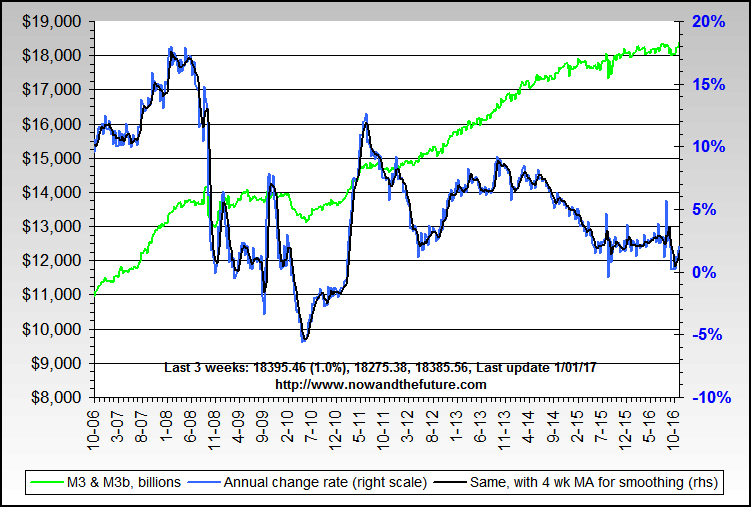
This chart shows the money supply over a longer time period (click on the image to get a better view). 1971 is when Nixon pulled us off the gold standard. Greenspan took over in 83. 2001 is when our monetary policy went bonkers and caused the current fiasco.

Chart 1


US Money Supply as measured by M3 (the best aggregate). The government quit reporting M3 in 2006 (I wonder why). M3B is a measurement now captured and maintained by commodity investors as an attempt to measure what M3 used to be.

Oy

Australia's Prime Minister blames "extreme capitalism" for the market turmoil.

Government spends trillions on defense and social policy in the 80s and needs an inflationary monetary policy to support it. We get a big ol bust in 87...and massive liquidity injections are used to bring us out...which gives us a short boom in the nineties followed by a bust in 2000 that just happens to coincide with the beginning of the greatest growth of government since the 30s, and the most inflationary government monetary policy yet to get us out...which leads to an even bigger bust and NOW...the most inflationary monetary policy EVER happening RIGHT NOW which may well lead to a nice but short-lived near-future boom that will land in an even bigger BUST.

Rampant, unstoppable, extraordinary government growth + government outright destruction of the value of our money = extreme capitalism.

Tuesday, October 14, 2008

Monday, October 13, 2008

Comparing The Two Economic Crisis Plans Rolled Out This Week

For Anyone Who Thought The Republicans Were The Free Marketeers and The Democrats Were the Bleeding Hearts:

Obama proposes:

1. A $3000 per-job tax credit for small businesses that create new jobs over the next few years.

2. Tax-penalty free withdrawals from retirement accounts.

3. 90-day foreclosure moratorium for homeowners.

4. A new government lending facility to provide cash to states and municipal governments.

#3 & 4 on the list are problematic, but not nearly as bad as this:

McCain proposes: $300 billion of government money to buy the mortgages of homeowners who are in danger of foreclosure. Ownership of those mortgages transferred to Fannie & Freddie and a new, lower interest rate is given to the homeowner.


Obama is proposing a big tax cut (absolutely the correct response to this crisis). McCain is proposing the biggest government takeover of private property since before I was born.


Ready for this? The social scientists at Yale and Columbia much prefer McCain's plan. So does NPR. Dear Lord, you should have heard them gushing this afternoon on Democracy Now.


The Obama campaign? They have called the McCain plan "too costly."

A good sign today.

No, not the Dow. That could mean anything.

Talking about the publication of this article in the UK's Independent. Check it out.

The Meaningless Nobel

The Peace Prize to Arafat a few years ago. Now the economics Nobel to Krugman? Early money that next time they award posthumously to Marx.

Sunday, October 12, 2008

Diluting the Tuna Melt Brand

A break from GFM for SLAM (Spencer Literary Agent Meltdown).

In September, it was looking good for the current novel. One agent came back to the well three times, one letter proclaiming he raced to the end of the partial request and was sad he didn't have more to read.

In the past few days, he and everyone else declined. Queries sent out over a span of months came flying back as rejections all at once. It's been a Bear Stearns freefall to zero wipeout. I wonder if Bernanke can arrange a fire sale of my manuscript to a more solvent writer.

Worth Watching to the End

Saturday, October 11, 2008

Where Were You During the Last GFM?

Stock market tanks. War with Iraq. President Bush. Hundreds of banks going under. A government "bailout" in the hundreds of billions.

I am of course referring to the late 80's / early 90's. The stock market crashed in 1987, the S&L crisis unfolded, the economy went into a slump, people wondered if they needed to buy a shotgun and lock their front door.

The good news: Not only did we recover, but we recovered into a massive good-times boom.
The bad news: if we judge only by the size of the government bailout (even adjusted for inflation), this one's about 5 times worse than that one.

This morning I was reminiscing with my wife about how weird I was in middle school. I owned an exercise machine that could either be a rower or a cross country skier, and I used it every day while listening to my "Rudolph Serkin Plays The Beethoven Sonatas" tapes on my walkman. Danny and I relentlessly practiced our jumpshots (the road to impressing the cholas at St. Charles began on the basketball court. He who could score big against Queen of Heaven might score big with Maricela).

I had no idea we were in a GFM. Did you?

Friday, October 10, 2008

Am I Opposed?

Opposed to?

The bailout plan: yes.
Buying equity in banks: yes.
Emergency lowering of the interest rates: yes.
More than a trillion dollars of money injected by the world's central banks: yes.
A stock trading hiatus while "we rewrite the rules.": yes

Do I blame them for trying any of this? No.

The world wouldn't stand for anything less than extraordinarily aggressive action from our governments. And there is broad agreement among the world's economists that the actions taken so far are the way to go.

But this is just uncool. It was garbage like this that turned what would have been a routine (if severe) money crisis in 1929 into a worldwide depression that lasted twenty years.

Credit Card Debt Crisis in the Wings?

That's the latest chatter. My suspicion is that it's already ON and is part of the reason this meltdown is so much worse than all but the grizzlies were predicting.

Other thoughts on this:
1. The credit card debt backed securities have ALREADY tanked and the investment banks that held them have gone under. They might even be undervalued at this point.
2. The banks with heavy exposure in this game are the aforementioned Big 3 uber banks who, as we speak, are getting bought into by the Treasury and are allowed to sell their bad mortgage debts to the government over the next few months.

Thursday, October 9, 2008

Where We're Headed - Will Happen

7. A few crazy-ass months to end 2008.
8. The worst of the credit crunch abates. The economy is in deep recession, but outright armageddon has been avoided. America is left with an economy newly injected with the heaviest dose yet of the Fed's funny money and the most nationalized American banking system since Andrew Jackson killed The Second National Bank.
9. Many second and third world economies go the way of Zimbabwe, with their governments only avoiding outright default by igniting hyperinflations that destroy their currencies. Pakistan is one of those countries and we all freak our sh*t over it. Only China is solvent enough to provide the sorts of emergency loans once provided by the United States. Some Kissinger or Soros or other old white dude is all over the Sunday morning talk shows calling China the world's new lone superpower. The "War on Terror" is quietly reigned in as a much weaker US is forced to pay attention to the desires of the rest of the world.

The Dow

I'm the berriest of bears, but even I think we're nearing or have already zoomed below a rational valuation of stocks. Of course, I don't know what Apple should be priced at any more than the next guy, but it looks to me like a good old-fashioned panic out there right now. I hardly have the expertise (or the net worth) to give anyone financial advice, but I personally will be increasing my 401K allocation.

Where We're Headed - Happening and Will Happen

5. In addition to buying their bad assets, the government floats taxpayer money into banks in exchange for equity rights, furthering the already strong connection between big banks like BofA, Chase, Citigroup and the government.
6. The Fed opens the floodgates, dwindling its reserves to the lowest rates in history.

Wednesday, October 8, 2008


Gunman Kills 15 Potential Voters In Crucial Swing State

Tweedle Global Hellfire or Tweedle Nail in the Coffin

Alternate Post Title:
If our candidates were named Mao and Stalin, which would you pick?

Alternate Alternate Post Title:
None of the Above

My readers know that I am no fan of democracy.

The McCaininites among you are used to hearing folks say they're not choosing your guy. Face it, you don't even like him, but are just choosing him because he seems a little bit less socialist.

But the Obamacons can't fathom why someone wouldn't vote their way, if nothing else than to ensure McCain stays out of office. Obama seems a little less eager to go after Iran. Isn't that enough for you to put up with any other flaws?

With GFM upon us, I ask you now to ponder the 10-percent increase on the top tax bracket Obama proposes. There's been a bit of flippancy about this (myself included) -- "yeah, his tax plan is sure-fire recession, but at least it isn't war with Iran."

But what about now, when we're already in the deepest recession in 100 years? How eager are you now to implement a new tax plan that's just plain retarded?

And don't forget - whenever Obama is asked, he's plenty eager to talk tough. We're all just guessing that deep in his heart, he really doesn't want World War Whatever even as he tells us we need to "take out" Pakistan.

No Good Deed....

Warren Buffett has been injecting millions of dollars into under-capitalized institutions. He's doing it in a way that, if he calculated correctly, he'll make a huge profit. He's also doing the economy an enormous service. Healthy firms need capital and are having a tough time getting it (the essence of a credit crunch), but if capital is put into unhealthy firms, no one benefits (and the capitalist loses big-time).

Someone needs to determine which firms get capital and which are left to die. This is the entire purpose of the financial sector.

But, with all the positive press Buffett is getting, I wonder...

How long before the other billionaires of the world are "asked" to inject more of their capital into the well-connected companies of the world?

Tuesday, October 7, 2008

Where We're Headed - Happened and Happening

Steps 1 - 4 (you're not ready for Step 5 yet).

1. Fannie & Freddie are nationalized (already happened)
2. The government writes itself a check to buy all the mortgage-backed securities it deems necessary (already happened).
3. The government orchestrates "bailout" mergers, rescuing the deposits in smaller banks and turning them over to a shrinking number of larger banks. These new banks are much more closely tied to the government than normal companies (happening now).
4. The government intervenes in the subprime mortgage market, re-negotiating better interest rate terms on volatile home loans (began Monday when Bank of America wrote down $8 billion on home loans initiated at Countrywide).

Curious

Your exercise for the night.

1. Go to trends.google.com
2. Search for Austrian economics

In addition to observing the trend, note the #1 city.

More regulation needed? Let's ask Europe.

An imperfect article that mostly gets it right. The key point:

"Who were the purchasers? They were by no means unregulated. U.S. investment banks, regulated by the Securities and Exchange Commission, bought piles of toxic waste. U.S. commercial banks, regulated by several agencies, including the Fed, also devoured large quantities. European banks, which faced a different and supposedly more up-to-date supervisory scheme, turn out to have been just as rash."

Or, as we're now learning, the heavily regulated European banks were quite a bit more rash.

Monday, October 6, 2008

The Best Article to Read about GFM

Everywhere you turn, you see Madeline Albright. She's standing in the median. She's in your cup of coffee. She's seated at your dinner table. She's using your bathroom.

You change your behavior. You go places where she hasn't appeared yet. You begin to distrust your eyes. You ask your friends what they're doing to avoid her. You do it too.

Tuna Melters, the most important information you have every moment of every day is what you see. You are constantly making decisions based on what your eyes tell you. When horrifying phantom Madeline Albrights start showing up everywhere, you have no choice but to mind them. Your behavior becomes absurd.

The most important information in an economy is pricing. Prices give us instant information about the perceived values of anything that's up for trade. Prices govern the flow of capital, sending money into channels of greatest value.

Loose money screws up the pricing system. Since the early 90's, and much more acutely from 2001 - 2004, the Federal Reserve has flooded the economy. The pricing system, particularly the price of money as expressed in the interest rate, has been nonsense, and our behavior has become absurd.

There's a lot to ponder right now. What's going to happen next? What do I do with my money? How can I protect myself?

More important than all of this is: why did this happen and what steps should the citizens of the world take to prevent it from happening again?

Take a read.

"Nothing is more vital to capitalism than capital, the financial seed corn dedicated to next year's crop. Yet we, believers in free markets, allow the price of capital, i.e., the interest rate on loanable funds, to be fixed by a central committee in accordance with government objectives. We might as well resurrect Gosplan, the old Soviet State Planning Committee, and ask them to draw up the next five-year plan."

Here's the rest:

http://online.wsj.com/article/SB122273029076687929.html

A Theme

There are ten million long, difficult articles in the world on the GFM already.  Go find one if you'd like.  I'll try to keep the linked content and the original content more concise.  To start, please forget whatever you think you know about GFM, especially if you think more regulation would have prevented this, or Wall Street has run amuck, of this is somehow a failing of capitalism, and start here:

Welcome

Tonight my brother asked that I put my opinions regarding the Global Financial Meltdown (GFM) in a blog.  So...until I get bored of this...